Luxury Home Libraries: Integrating Furniture, Lighting, and Experience
Designing a luxury home library is not an exercise in nostalgia or visual indulgence alone; it is a sophisticated orchestration of furniture, lighting, spatial logic, and user behavior. In my experience working with high-end residential clients—many of whom are furnishing their homes for the first time or renovating long-term residences—the library often becomes a psychological anchor of the home. It is where focus, identity, and quiet authority converge.
According to a 2024 Houzz Renovation Trends Survey, 38% of homeowners undertaking major renovations now request at least one purpose-built quiet or reading space, a figure that has risen steadily from 24% in 2019. This growth reflects a broader lifestyle shift: remote work, digital fatigue, and a renewed appreciation for tactile, analog experiences such as books, handwriting, and contemplative reading. A luxury home library responds directly to this shift, but only when executed with genuine expertise.
Furniture as the Structural Backbone
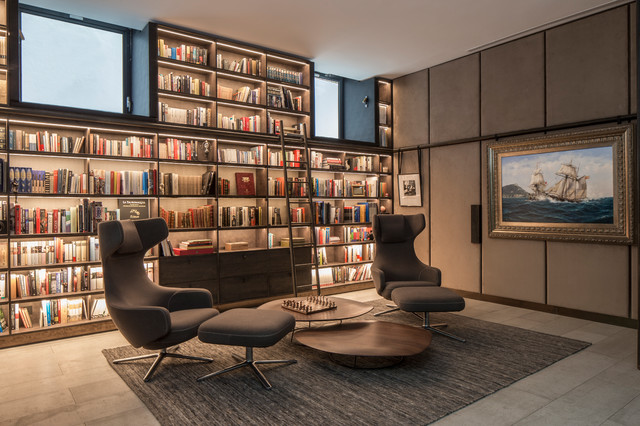
High-end library furniture must balance permanence with adaptability. Shelving systems are the most dominant element, and their design should begin with structural logic rather than decoration. In professionally executed projects, shelving depth typically ranges between 280–320 mm for standard books and up to 380 mm for art volumes, ensuring ergonomic access without visual heaviness. Solid hardwoods such as American walnut, European oak, and ash remain dominant due to their dimensional stability and aging characteristics. A 2025 European Furniture Industries Confederation report shows that over 62% of luxury residential casework uses solid or veneered hardwood rather than MDF-based alternatives.
From a craftsmanship perspective, joinery quality is non-negotiable. Hand-finished mortise-and-tenon or concealed steel-reinforced joinery provides structural integrity while preserving visual continuity. I consistently advise clients to avoid over-modular systems marketed as “luxury” but designed for speed rather than longevity. True authority in furniture design comes from precision, not excess.
Seating, Ergonomics, and Human Comfort
A library that looks refined but fails in comfort quickly loses its purpose. Seating selection should be informed by use duration rather than appearance alone. Reading chairs benefit from seat heights between 420–450 mm, lumbar support angles of approximately 100–110 degrees, and armrest heights that allow relaxed shoulder positioning. These specifications are not aesthetic preferences; they are derived from ergonomic research published by the International Ergonomics Association.
In high-end projects, I often recommend a mix of seating typologies: a primary reading chair, a secondary lounge seat, and a compact writing chair. This layering supports different modes of engagement—deep reading, casual browsing, and short writing tasks. Upholstery materials matter deeply here. Full-grain aniline leather and high-density wool blends outperform synthetics in thermal regulation and aging behavior, contributing to long-term trust in material selection.
Tables and Functional Surfaces
Tables in a luxury library should never be decorative afterthoughts. Writing desks, side tables, and reading tables require careful proportioning to ensure usability. Desk heights typically range between 720–740 mm, while side tables should align within 30 mm of the seat arm height for functional reach. Materials such as leather-wrapped surfaces, solid wood slabs, or stone inlays are chosen not for trend alignment but for tactile engagement.
In my professional judgment, overly minimal glass or lacquered surfaces undermine the experiential depth of a library. Users subconsciously associate weight, texture, and resistance with intellectual seriousness—an insight supported by environmental psychology studies published in the Journal of Interior Design.
Lighting Strategy: Precision Over Drama
Lighting defines whether a library is usable or merely photogenic. High-end residential lighting design relies on layered illumination: ambient, task, and accent. According to a 2024 Lighting Research Center study, layered lighting improves reading comfort by 41% compared to single-source solutions.
Ambient lighting should provide uniform background illumination at approximately 300–350 lux, typically achieved through concealed coves or architectural fixtures. Task lighting—often adjustable floor lamps or integrated shelf lighting—should reach 500–600 lux at reading surfaces without glare. Accent lighting highlights book spines, textures, and architectural rhythm, reinforcing visual depth.
Importantly, color temperature matters. Libraries benefit from warm-neutral ranges between 2700K and 3000K, which enhance wood tones and reduce eye fatigue. I advise clients to avoid smart lighting systems that prioritize novelty over reliability; trust in lighting comes from consistency and intuitive control.
Spatial Planning and Circulation
Spatial intelligence separates professional design from decoration. A successful library balances density with breathability. Circulation paths should maintain a minimum width of 900 mm to prevent congestion, while seating clusters benefit from acoustic buffering through rugs, drapery, or book mass.
In renovations, libraries often occupy repurposed rooms—former dining spaces or oversized bedrooms. In these cases, proportion correction through vertical shelving, ceiling articulation, and controlled lighting restores spatial dignity. A 2025 Residential Architecture Survey found that rooms with vertical emphasis are perceived as 18% more formal and focused, reinforcing the library’s role.
Personal Perspective: Why Libraries Still Matter
From my professional experience, clients who invest thoughtfully in a home library consistently report higher emotional attachment to their home. Unlike trend-driven spaces, libraries age gracefully. Books accumulate stories, furniture develops patina, and lighting becomes familiar rather than intrusive.
I believe the true value of a luxury library lies not in its visual impact but in its behavioral influence. It encourages slower rhythms, deeper thinking, and intentional solitude—qualities increasingly rare in contemporary living. This is why shortcuts, superficial materials, or purely aesthetic decisions erode trust over time.
Conclusion: Authority Built Through Integration
Luxury home libraries succeed when furniture, lighting, and spatial planning operate as a cohesive system rather than isolated decisions. Expertise is demonstrated through ergonomic precision, material honesty, and lighting discipline. Authority emerges from craftsmanship, not excess. Trust is earned when the space performs consistently over years of use.
For first-time homeowners and those preparing renovations, a well-designed library is not an indulgence—it is a long-term investment in daily quality of life. When approached with clarity, research-backed decisions, and respect for human experience, the luxury home library becomes one of the most enduring and meaningful spaces in a residence.